Letterpress Love

In my last post I divulged my weakness for pretty much any art form and all art materials. When I discovered letterpress printing, I fell in love with yet another means to a creative end.

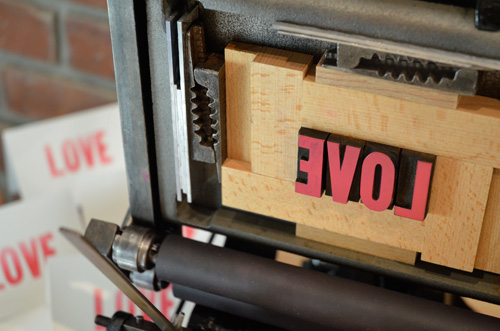
What is letterpress?  The short story is it’s relief printing using movable type or a custom made plate by locking it in the press, inking it and rolling or pressing against paper to form an impression. The long story can be found here.

One of the reasons I felt drawn to letterpress was my desire to get back to old school methods of communication design after having spent years and years designing digitally as an interactive designer. I love the look, the texture of the paper, and the tactile nature of the relief print. What’s particularly cool about letterpress today is the merge of old (letterpress) and new technology (designing digitally); wikipedia sites this as the renewed interest in letterpress and the rise of “digital letterpress.”

An interesting fact pointed out on wikipedia:

The goal before this revival was that you could not tell there was an impression, the type contacted the paper enough to transfer the ink but not leave an impression. However today, when speaking of letterpress, the goal is to have that impression be evident, to distinctly note that it is letterpress.

Sort of funny how goals change over time. Before the digital printing age we strived to achieve the smooth digital printing look; now we pay more for relief printed invitations, posters or the like!

My letterpress story:

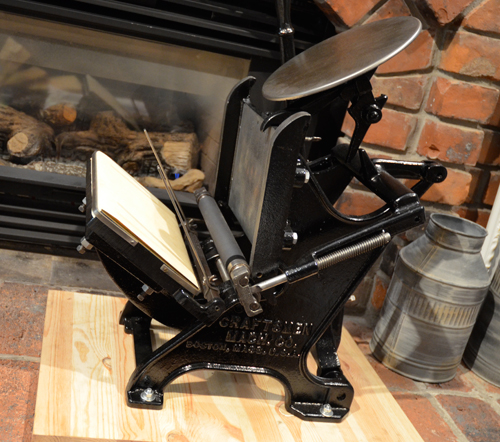
My intrigue started when I had started seeing really beautiful wall art letterpress posters and this fun letterpress Tooth Fairy Certificate!  After a quick internet search, I found the perfect introductory workshop to try my hand at the process and to learn first hand what letterpress printing is all about. It was at this workshop that Tanya, of Snap + Tumble, told me about Don Black, the guy to know if you’re into any sort of linecasting or letterpress printing. I was so enamoured by the workshop that I went straight from Tanya’s home studio to Don Blacks (which happens to be only a few blocks away) to learn more.  It was during this first visit, my first exposure to the letterpress process really, that I put my name down for a press, a Craftsmen table top 5 x 8 platen press. They often have wait lists for presses than come in and need refurbishing.

 I can’t even describe what came over me at Don Black’s that day. I saw a line up of three table top presses and before I could think about what I was saying I had already asked if they were spoken for and put dibs on the black one! It was a sort of out of body experience. 😉

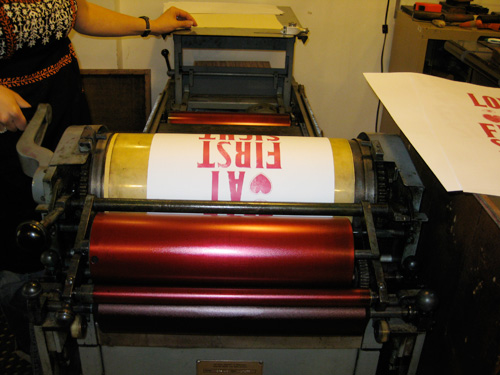
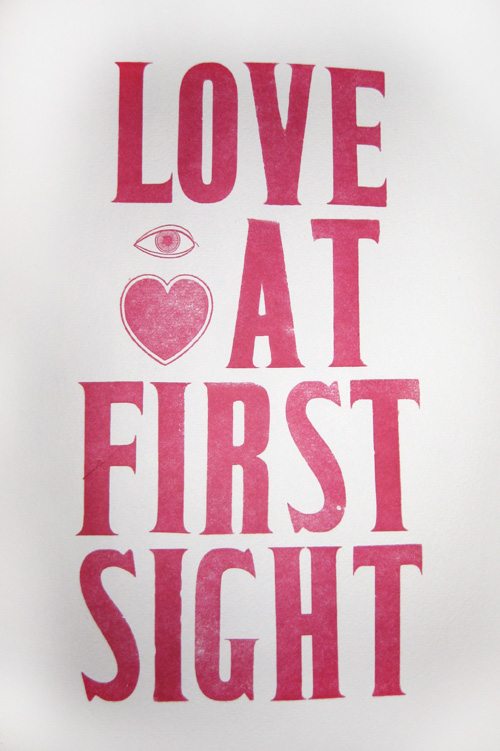
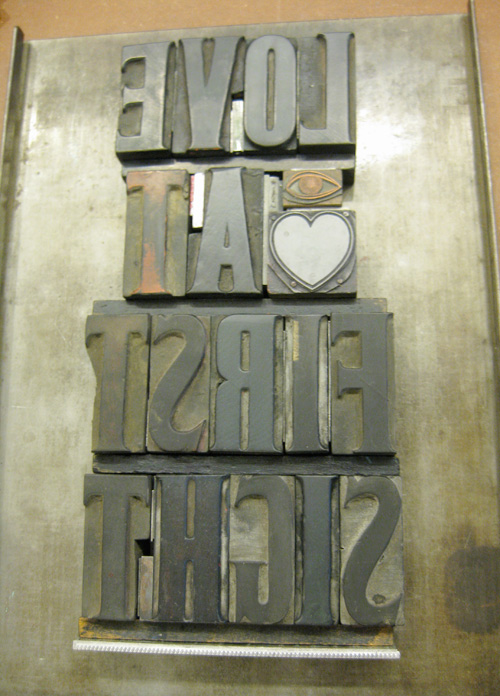
A few months later I took another workshop, this time at Kozo Studio, where I created the “Love at first site” poster on a Vandercook SP 15.. that was pretty cool. Thankfully Kozo Studios is not close to Don Black’s and I didn’t commit to buying a Vandercook! The photos below show how massive this press is!
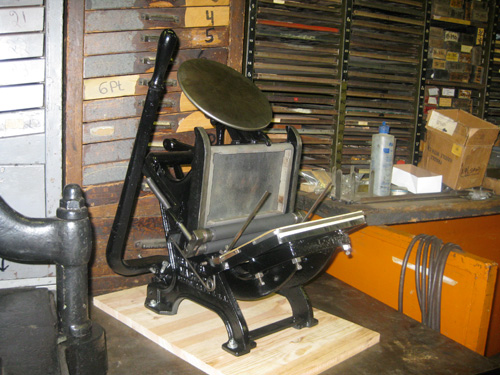
Later that summer my press was ready! Made the trip back to Don Black’s.. a really amazing place!
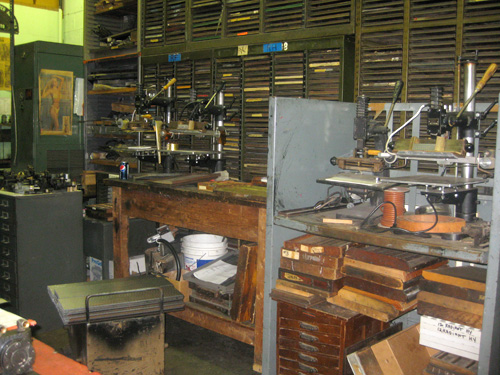
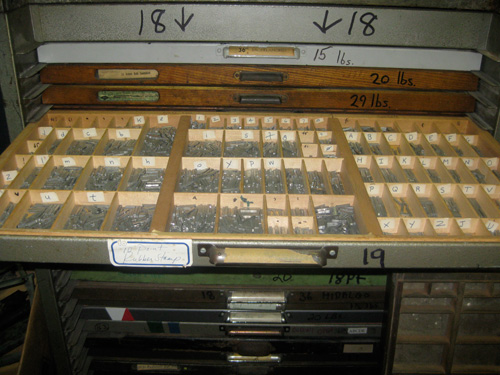
I refrained from going nuts buying metal and wood type and vintage cuts (images) but I picked up a few cuts and took a picture of this tray so that I could remember how to set up my type in a tray at home.
I’d like to say that the rest is history but by the time I picked up my press I was pregnant with baby #2 and short on studio space, so my little but heavy press went into storage until recently. After a bit of research and a trip to Above Ground Art Supplies, I’m ready for the experimenting process to begin!

I’m just at the start of my letterpress exploration. What used to be a fairly rigid lesson in typesetting and printing, now is only limited by imagination. But I feel like the sky’s the limits with creative opportunities. Like any medium, it’s the vehicle to creation. The true art is in the idea. I have a few… I’ll be sure to share them here along my journey.

Creative Obsessions

I know I’m not the only creatively obsessed person out there, but lately I’ve been wondering if I should seek out a support group to work through how to manage all of my creative compulsions.  You see, I could probably open an arts and crafts store based on the diversity and abundance of art supplies that I have available… in my home. 

I have the usual arts and crafts supplies: glue guns, glue, glitter, tape, pom poms, ribbon etc. Then there is my sewing machine and the small boutique store’s worth of fabrics that goes along with that, not to mention magazines, accessories and patterns. Then there’s my scrapbooking ‘supply’ – again another small store’s worth of stuff. My paint and art supplies including canvases that have collected a bit of dust unfortunately. The embroidery thread and looms, yarns and knitting needles. Lino carving tools, clay and sculpting tools… And my most recent creative endeavor.. my Craftsmen table top letterpress.

Craftsman Letterpress

My beloved press deserves a post of it’s own.. (coming soon), but let’s get back to managing all of the creative stuff!

I’ve come up with a 10 step plan to get a handle on things here in my store, er, I mean home. Here it is:

  1. Admit I have a problem.
  2. Designate craft spaces in my home – art studio space, basement cabinet, etc.
  3. Sort like with like.. all ribbons in one drawer or case or basket, you get the idea..
  4. Organize according to type of art project. For example, all kids arts and crafts supplies are kept in the play space area, all sewing related items go in art studio…
  5. Create a list of creative project ideas. Pick ONE project and start it.. then finish it!
  6. Take step 3 a bit further and commit to at least one project a week.
  7. Stop buying more supplies.
  8. Set my intentions to use a supply that hasn’t been touched in a while and if it doesn’t happen donate it to a local school.
  9. Celebrate the creations by posting them here.
  10. Edit which creations will be kept, gifted or discarded to avoid that whole other problem.. storing art creations!

David Kelley: How to build your creative confidence

I’ll admit I have a tear in my eye as I write this post about this super touching and powerful talk about the loss of creative confidence that happens in childhood given by David Kelley at Ted earlier this year.  Kelley discusses his battle with cancer and how it inspired him to consider his purpose in life to which he explains:

“the thing i most wanted to do was to help as many people as possible re-gain the creative confidence they lost along the way.

I really believe that when people gain this confidence… they actually start working on the things that are really important in their lives. We see people quit what they’re doing and go in new directions. We see them come up with more ideas so they can choose from better ideas. They make better decisions.”

To help him on his quest, he asks:

  • Don’t let people divide the world into the ‘creatives’ and the ‘non-creatives’.
  • Have people realize they are naturally creative and let their ideas fly.
  • Achieve self-efficacy; Do what you set out to do to reach a place of creative confidence.

The last point: achieve self-efficacy. Seems a little easier said than done, I’d say. According to Psychologist Albert Bandura whom Kelley references in his talk, four factors affect self-efficacy (according to Wikipedia).

1. Experience – Success raises efficacy, while failure lowers it. However “children cannot be fooled by empty praise and condescending encouragement”.  As parents we need to most definitely be aware of that. Instead, children benefit from consistent recognition of real accomplishment.

2. Modeling – When we see someone succeeding, our own self-efficacy increases; when we see people failing, our self-efficacy decreases.

3. Social Persuasion – Manifests as direct encouragement or discouragement from another person. Discouragement is generally more effective at decreasing a person’s self-efficacy than encouragement is at increasing it.

4. Physiological Factors – Perceptions of physiological responses to stressful situations can markedly alter self-efficacy. For example getting ‘butterflies in the stomach’ before public speaking will be interpreted with someone with low self-efficacy as a sign of inability, thus decreasing self-efficacy further, were high self-efficacy would lead to interpreting such physiological signs as normal and unrelated to ability.

Seems to me that as parents there is A LOT WE CAN DO to promote positive self-efficacy in our children. My thoughts are:

  1. Drop the empty praise altogether. Instead give recognition for good work and better yet allow the child to feel good about mastering particular experiences for him or herself before jumping in to say ‘Good Job’!
  2. Provide opportunities for kids to see others succeed. Perhaps it’s as simple as taking them to the park and watching other kids succeed at the monkey bars or spending time at the pool with a relative that’s a good swimmer.
  3. If you don’t have anything nice to say don’t say anything at all. That’s my commentary with regards to point #3 above – social persuasion. Keep positive with encouragement.
  4. Recognize when your child is experiencing stressful situations (say the first few weeks of school or before a dance recital) and talk about it. Let them know that it’s okay to feel butterflies. It’s normal and natural.

Last thing I want to mention in relation to this video is that the subject of creative confidence reaffirms my blog title “Keeping Creativity Alive”. For a while now I’ve been contemplating changing the name.. to something more positive, more unique and more, well.. creative. But this video reminds me of my ultimate mission and passion: to help parents help kids grow creatively with confidence and has me thinking that my name might be appropriate after all… for now anyway. I’d love to hear your thoughts!

What’s Your Manifesto?

Manifestos completely inspire me. Carefully thought through and beautifully designed poster manifestos that is. Like the following letterpress posters I came across on Pinterest today by Aardvark:

Another truly inspiring manifesto is by Bruce Mau Design, called “Incomplete Manifesto for Growth”.  Some of my favourite points:

  • Love your experiments (as you would an ugly child).
  • Begin anywhere. “…not knowing where to begin is a common form of paralysis.”
  • Don’t enter awards competitions. “Just don’t. It’s not good for you.” – really love this!

Then there’s Lululemon’s manifesto:

“Creativity is maximized when you are living in the moment.” I don’t know about you, but this one jumps out at me!

Wikipedia defines a manifesto as: a written public declaration of the intentions, motives, or views of the issuer, be it an individual, group, political party or government. It often is political in nature, but may present an individual’s life stance.

Probably not a bad idea for us all to write a manifesto to serve as a reminder of goals and keeping our values in check. Adding this to my list of things to do!

Giving Thanks

We spent most of this past weekend at our family cottage enjoying the gorgeous colours of the fall on this wonderful Thanksgiving weekend.

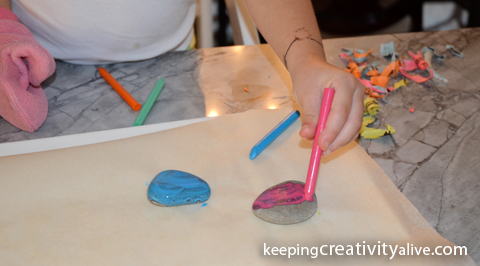
Breathing in fresh air seems to awaken my creative spirit. I find that all I want to do is get creative when I’m up there. This time we decided to make place card stones to place on our table for the big dinner (inspired by The Artful Parent’s Thankful Stones).  We successfully played around with the project at home a couple of weeks ago…

… but this time our crayon colours came out too dark and it was too hard to read the names.

Right about the time that we were discovering that our project wasn’t working so great, my handy dad appeared with a piece of birch trunk and offered to cut it up into small discs that we could use for name cards for our Thanksgiving dinner table. He’s very creative! They worked out great!

In honour of giving thanks on this beautiful Thanksgiving weekend, I decided that we could use the extra birch pieces to play a fun game. This is how it worked:

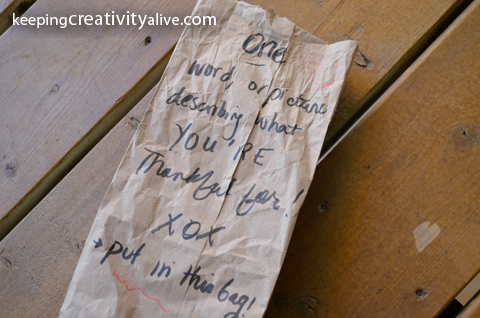
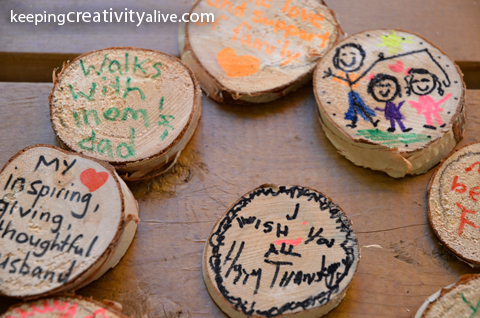
When everyone arrived for dinner I asked each person to write or draw what they are thankful for on the piece of wood and secretly put it in this paper bag.

Once I had them all, I displayed them in the center of our table for all to enjoy during dinner.

At the end of our dinner we had fun reading the thankful words, drawings, and messages and guessing who they came from!

We had a blast guessing who wrote what. Some were obvious, others not so much! We all guessed wrong for “walks with mom and dad”. Turns out it was Archie’s, my brother’s dog!

Happy Thanksgiving to all that are celebrating today!

The Global Cardboard Challenge

Caine’s Arcade is an absolute touching story. What pulls my heartstrings the most is the proud look on Caine’s face and his sweet toothless smile!  There’s NOTHING like the look of pure joy on a child’s face when they’ve accomplished something they’re proud of.

What’s more is that this story and the response to it inspired The Imagination Foundation. “The Imagination Foundation’s mission is to find, foster, and fund creativity and entrepreneurship in kids like Caine.”

Today is actually the Global Cardboard Challenge where people around the world are hosting events for kids to create using just cardboard and their imaginations. Anyone anywhere can play. “The idea is just to bring the whole world together to play and celebrate creativity and imagination.”

What a beautiful story and important project. Love that Nirvan Mullick, the filmmaker behind Caine’s Arcade, says “this all started with going to buy a door handle” but ended up buying a funpass! He not only found joy in discovering Caine’s arcade but did something to celebrate it. Then did something even bigger with the attention his short film received by keeping the creative momentum going and starting the Imagination Foundation.  Goes to show that when you believe in something and put your heart into it, amazing things happen. I’m inspired… again.

Creating Innovators

Creating Innovators. The Making of Young People Who Will Change the World addresses these questions through in-depth profiles of young innovators and the adults who have made a difference in their lives, as well as vivid descriptions of innovation-driven classrooms and places of work.

YES! This is what my intention for this blog is all about. Looking at what we can do as parents and caregivers and teachers to foster creative minds that will innovate and make positive changes in the world!

Some quotes from the video that resonate with me:

“Raising someone with an intention that they’ll be an innovator is actually different than raising a child that you want to behave all the time and be quite compliant.” – Annemarie Neal, Cisco Vice President

“Let them fail because they are going to learn more from that than we can ever teach them directly.”

“Our success is measured by the rate of innovation.”

This leaves me pondering: what more can I do to encourage my children to be innovators?

Here are some answers to my own question; some of which I’ve instinctively been practicing. It’s a work in progress and there’s certainly always a lot of room for pushing and challenging myself to inspire and create learning opportunities for my kids at home. In any case, this is where I’m at in the process:

  • Provide opportunities to practice decision making.
  • Support the decision made.
  • As per supporting and encouraging independent thinking via decision making (as an example), build confidence. One example is standing behind decisions that are made. Providing positive feedback and praise when appropriate and relevant. Or acknowledging good thinking and new ideas: “that’s a great idea!”
  • Provide problem solving activities regularly.  A lot of times children will come up with their own challenges to solve. Ha! Like the time V wanted to get through the fence to visit the neighbourhood girls. She decided she’d use scissors to cut a hole in the wood to crawl through. When that didn’t work she ran inside to get a pencil to draw a door that she could open. This went on for a while! I can’t actually remember how she resolved her challenge.
  • Dedicate time each day where children can follow their own interests and curiosities, daydream or pursuit a project/game/activity idea.

What are ways that you foster innovation with your kids?

Books That Inspire

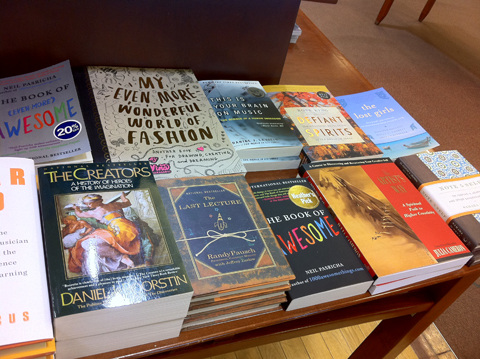
Do yo ever get into a trance like state as you walk through certain stores that inspire you? That’s what happens to me when I walk through a bookstore. Last time there, as I walked down the main aisle, I was captivated by a number of beautiful cover designs that spoke to me… a few I was familiar with but many, I hadn’t seen before.

Then I looked up and saw this…

Ah ha! No wonder I was so enthralled with every single book on this table!

Some titles I found here:

The Artist’s Way by Julia Cameron

The Last Lecture by Randy Pausch

The Innovator’s Cookbook by Steven Johnson

The Brain Training Revolution by Paul E. Bendheim

Wreck this Journal by Keri Smith

After deciding to pick up Unstuck by Noah Scalin (which I’m LOVING) I walked around to the other side of the table… Live Creative.. very clever.

Makedo Project 1

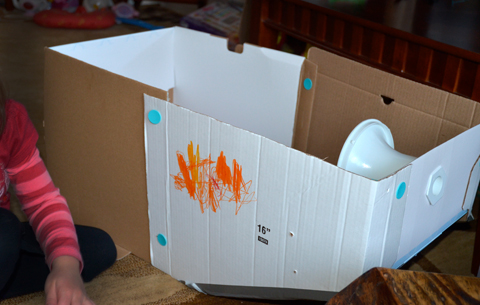
The possibilities are really endless with these cardboard connectors! It was also the perfect activity to take to the cottage since there always seem to be boxes around and they come in a small cylinder container making it very easy to transport.

V is still too young to cut the boxes and actually poke the holes for the connectors but she directed the entire process! Surprise surprise!  It started as a zamboni… the amount of snow outside inspired that idea!

But then evolved into a fire truck.. inspired by the flame in the wood stove…

… then a sleigh…

Very very fun! What’s really cool about these very simple (I don’t even know what to call them…) doo dads is that it’s open ended and creates the opportunity for A LOT of play. It starts with the planning and gathering materials, then there’s building and problem solving and finally playing, playing and more playing. At which point it all starts all over again with decorating, adapting and playing in different ways.

Happy Valentine’s Day